What Crosses

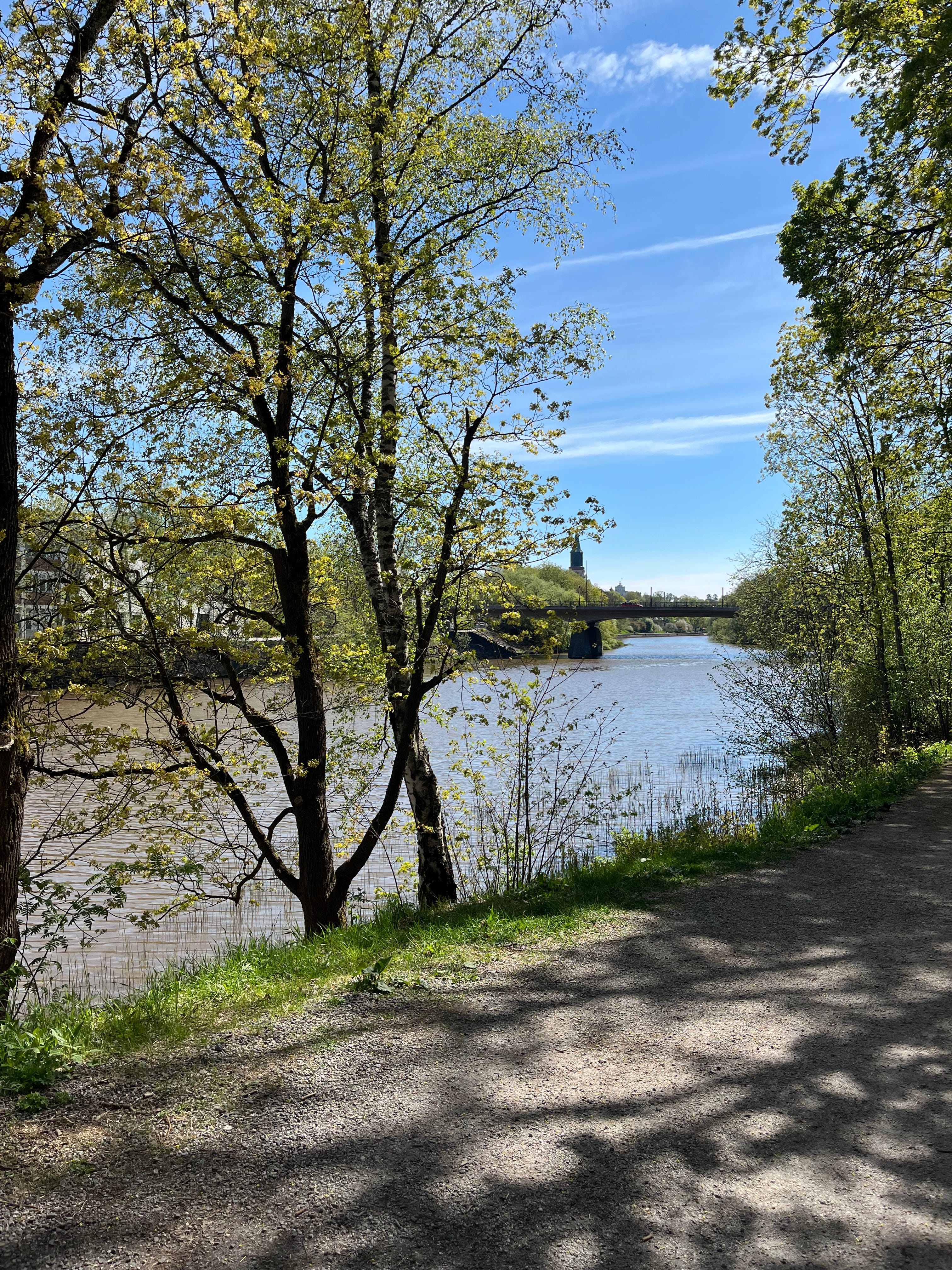
In the City of Turku, Finland the river tells you where you are. Täl puol jokke, tois puol jokke: this side of the Aura, and the other side. Usually the cathedral’s bank is treated as “this side,” with everything across the water becoming “the other.” It’s an old way of speaking, half-forgotten now, and people aren’t always sure which side they’re on.
At the crossing the boundary is small but real: you wait. The signal holds you on one bank until it lets you go. A bicycle went through before me. To reach the other side people take the bridges, or the small ferry that has carried walkers over the same short stretch of water for more than a century. We cross slowly, a few at a time, when we’re allowed.
The sound doesn’t wait. Tires on dry asphalt, continuous, grainy, a dry roll rather than a hiss. It comes from across the water as easily as from beside me. Whichever bank I stand on, the hum is already there. It doesn’t recognize the division the river makes.
Something finer crosses too, though I only know this from reading, not from standing there. Rubber and road grinding each other small. Plastic, nicotine pouches, fragments worn down far enough to travel, carried by the Aura out to the Baltic. The river’s direction shifts with the day, and sometimes the water reverses its movement entirely.
So the crossing holds two logics at once. For us the river is an edge, a thing to be crossed on purpose, this side and the other side. For the matter we shed it is a route, open the whole way down. I keep thinking about that: the same water that divides where we can walk carries away what we never notice leaving.